
Indoor Security Cameras: How They Work For Home Monitoring And Safety

Indoor Security Cameras: Performance and Installation Considerations
Optical characteristics and placement are primary determinants of usable footage. Field of view, focal length, and sensor size influence the balance between scene coverage and detail resolution. A wide-angle lens may capture an entire living space but render facial detail at a distance less legible, while a narrower lens concentrates detail in a limited area. Mounting height matters: placing a camera near eye level can reduce occlusion of objects but may be more intrusive than ceiling placement. Practical installations often involve iterative repositioning to reduce blind spots and optimize coverage for likely events.
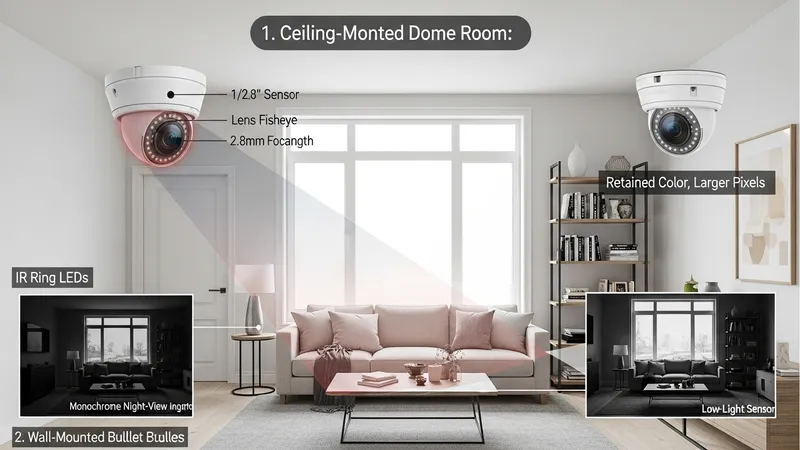
Lighting conditions affect image quality and the choice of sensor technology. Infrared illumination can provide reliable monochrome images in darkness, while low-light sensors with larger pixel sizes may retain color and detail at reduced lighting levels. Cameras positioned opposite bright windows or light sources may suffer from silhouette effects, so angle and location adjustments are common to mitigate backlighting. Some devices include wide dynamic range (WDR) processing to handle scenes with mixed lighting, which can improve facial recognition in high-contrast environments.
Network bandwidth and codec configuration shape operational performance. Continuous 1080p streaming at higher frame rates requires significantly more upstream capacity than intermittent event recording at reduced frame rates. Using efficient codecs such as H.265 can lower bandwidth and storage needs, but compatibility with viewing and storage infrastructure should be confirmed. Wired Ethernet or PoE can provide more consistent throughput than congested Wi‑Fi, though mesh networking or modern dual-band routers often deliver acceptable wireless performance for many indoor deployments.
Power and physical security considerations influence reliability and maintenance. Wired installations reduce battery maintenance but may require professional routing of cables. Battery-powered devices permit flexible placement but come with duty-cycle considerations and may need periodic recharging or replacement. Physical tamper resistance—such as secure mounts or screws—can deter casual interference, and concealing cables can reduce accidental disconnection. Regular inspection of mounting hardware, adhesive integrity, and environmental factors such as humidity may extend operational life and reduce unexpected downtime.