
Work From Home Typing: How Online Typing Jobs Function And What To Expect

Work-from-home typing describes remote roles where an individual converts spoken or handwritten material into digital text, enters structured information into databases or spreadsheets, formats documents, or produces typed content for administrative purposes. These roles typically rely on a steady internet connection, a word processor or spreadsheet application, and a workflow that moves files between a client or platform and the remote worker. Tasks can range from short-form data entry to longer transcription assignments that require listening and typing from audio, and each type follows distinct quality and turnaround expectations.
Functioning remotely, typing roles often follow predictable pipelines: a task is posted or assigned, files are downloaded, the worker completes the typing and formatting, and the deliverable is uploaded or submitted for review. Compensation arrangements may vary and can be structured per hour, per task, per word, or per minute of audio, depending on the client or platform. Communication about clarifications, file formats, deadlines, and revisions usually happens through email, messaging systems, or platform-specific interfaces. Data privacy, accuracy standards, and version control are common considerations throughout these exchanges.
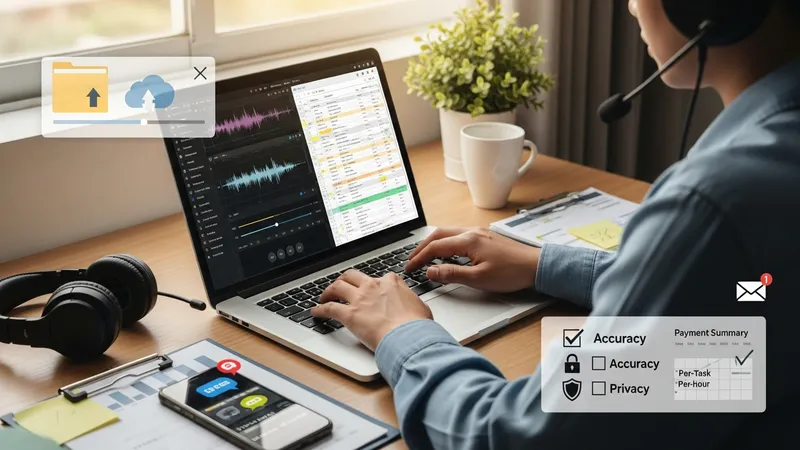
- Transcription and captioning — converting recorded speech into readable text or time-coded captions; tasks may involve verbatim transcription or light editing depending on client guidelines. See a general overview: Transcription (Wikipedia).
- Data entry and form completion — transferring typed values into spreadsheets or database forms, often requiring template adherence, consistent formatting, and basic validation. See a general description: Data entry (Wikipedia).
- Document preparation and content typing — producing, editing, or formatting documents such as letters, reports, and emails using word processing tools and style guides; work can include applying templates and proofreading. Reference: Google Docs: Create & edit documents.
Different task categories may demand different software and quality checks. For example, transcription work often uses audio playback tools, timestamping conventions, and noise-reduction techniques to support accurate typing. Data-entry assignments typically depend on spreadsheet functions, drop-down validations, and consistent input formats to reduce downstream errors. Document preparation can involve style guides, consistent heading structures, and file-format conversion. Understanding the expected deliverable format ahead of time can reduce rework and clarify whether light editing or strict verbatim capture is required.
Turnaround expectations and scheduling vary by assignment type and client needs. Short data-entry tasks may be expected within hours, while longer transcription tasks commonly allow days, depending on length and complexity. Remote schedulers often negotiate deadlines based on estimated words-per-hour or minutes-per-hour completed; these estimates can vary widely with audio clarity, familiarity with topic vocabulary, or the presence of multiple speakers. Workers and providers may use sample tasks or testing procedures to estimate realistic completion rates for planning purposes.
Quality assurance practices may include self-review, automated spell-checking, peer review, or client spot checks. Many platforms and clients specify accuracy thresholds, formatting checklists, and allowable revision counts. For tasks involving sensitive information, secure file transfer methods and data-handling policies are often requested; workers may be asked to follow nondisclosure provisions or basic data-protection steps. Clear metadata (file names, timestamps, version numbers) helps maintain traceability when multiple revisions occur.
Tools used in remote typing roles typically include general-purpose editors, specialized transcription players, and collaboration platforms. Common patterns include working from shared document links, using standardized templates, and uploading final files in agreed formats such as .docx or .csv. Workers may adopt time-tracking or task-management methods to record effort against deliverables. These operational practices can influence predictable throughput and support transparent communication about capacity and scheduling.
In summary, work-from-home typing roles consist of a range of remote text-focused tasks that follow defined input-to-delivery workflows, with variations in tools, timing, and quality controls according to task type. Assignments may require different software, turnaround expectations, and verification steps, and clear specifications from the requester can reduce ambiguity. The next sections examine practical components and considerations in more detail.