
Indoor Security Cameras: How They Work For Home Monitoring And Safety

Indoor security camera systems are devices designed to capture visual and audio information inside a residence for routine monitoring and situational awareness. A typical system combines an optical sensor, lens, processor, and connectivity components to convert light into digital video streams. These streams may be processed locally on the device or transmitted to remote servers or local storage for later review. Sensors and on-board software often detect motion or changes in a scene, while integrated audio components can provide two-way communication in some designs. Power can be provided by mains, Power over Ethernet (PoE), or battery in portable models.
Hardware and software components work together to deliver usable monitoring. Image sensors (CMOS) determine sensitivity to light, while lenses and field of view define coverage. Infrared LEDs or low-light sensors may support night-time imaging. Software functions commonly include motion detection algorithms, video compression codecs (e.g., H.264/H.265), and user-access controls. Connectivity options such as Wi‑Fi, Ethernet, or proprietary mesh networks affect latency and reliability. Many systems allow configuration of sensitivity, notification preferences, and privacy zones to limit capture of certain areas within a room.
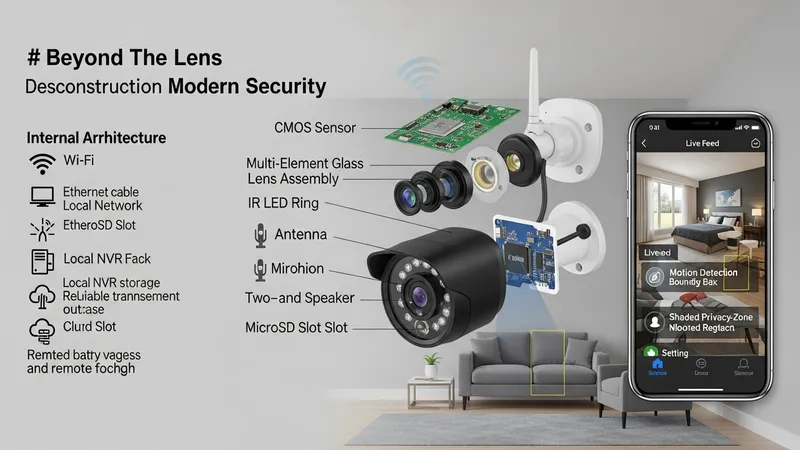
- Wi‑Fi cloud-enabled indoor camera — a compact device that streams encrypted video to cloud servers for remote viewing and optional history retention.
- Local-storage camera with microSD or network-attached storage (NAS) — records footage on-site to avoid continuous external uploads, often supporting scheduled overwrites.
- Pan-tilt-zoom (PTZ) indoor camera — provides motorised horizontal/vertical adjustment for broader coverage and can follow motion within a room when allowed.
Indoor cameras commonly provide a mix of automated detection and manual review. Motion detection can trigger recording, clip creation, or alerts, and configurations may allow sensitivity adjustment to reduce false positives from pets or lighting changes. Two-way audio permits verbal interaction through an app or a dedicated controller; this feature typically depends on microphone and speaker hardware plus secure transport of audio data. Video quality and bandwidth needs correlate with resolution and frame rate choices: higher resolution increases storage and network requirements, so many systems allow users to select lower-resolution continuous recording alongside high-resolution event clips.
Storage approaches affect privacy and access patterns. Cloud storage often simplifies remote access and off-device redundancy but may involve recurring fees and reliance on provider security practices. Local storage (microSD or NAS) keeps data within the home network and can limit external exposure, though it requires local management and may be vulnerable if the local network is compromised. Hybrid approaches are also available, where short event clips are uploaded while continuous recording stays local. Encryption of data in transit (TLS) and at rest is a typical security consideration when comparing these methods.
Network and connectivity factors play a practical role in performance. Wi‑Fi signal strength, channel congestion, and router capabilities can influence video latency and reliability. Using wired Ethernet or PoE can improve stability and reduce dependence on wireless conditions, but may limit placement flexibility. Bandwidth budgeting is important: continuous high-resolution streaming can consume significant upstream capacity, so many users opt for event-triggered uploads or adjustable frame rates. Firmware updates, secure passwords, and network segmentation (placing cameras on a separate VLAN) are common recommendations for reducing exposure to unauthorized access.
Siting and optical performance determine how effectively a camera monitors a room. Field of view and mounting height influence blind spots and the level of detail capture; for example, a wide-angle lens covers more area but reduces face detail at distance, while narrower lenses provide more detail in a focused zone. Lighting conditions affect both sensor choice and camera placement: avoiding backlighting and glare improves image clarity, and infrared illumination may be appropriate for low-light detection while producing monochrome night images. Consideration of occupant privacy and legal norms often guides decisions about where to place devices.
Legal, ethical, and privacy settings shape how indoor monitoring is deployed. Many jurisdictions regulate recording of audio or private conversations and expect reasonable notice to household members or guests. Configuration options such as disabling audio, defining privacy zones, and setting retention durations may help align use with local expectations. Systems that allow multi-user access typically provide role-based permissions to control who can view live streams or download recordings. The next sections examine practical components and considerations in more detail.