
AI CRM Software: Understanding Automation, Analytics, And Personalization

AI CRM Software: Customer Analytics and Predictive Scoring
Customer analytics in AI CRM software typically encompass descriptive reporting, segmentation, and predictive scoring. Descriptive analytics summarize past interactions and outcomes, while segmentation groups contacts by shared attributes or behaviors. Predictive scoring uses historical labeled outcomes to estimate probabilities for future events like conversion or churn. These scores are probabilistic and may serve as one input among others for human decision-making rather than as absolute determinations.
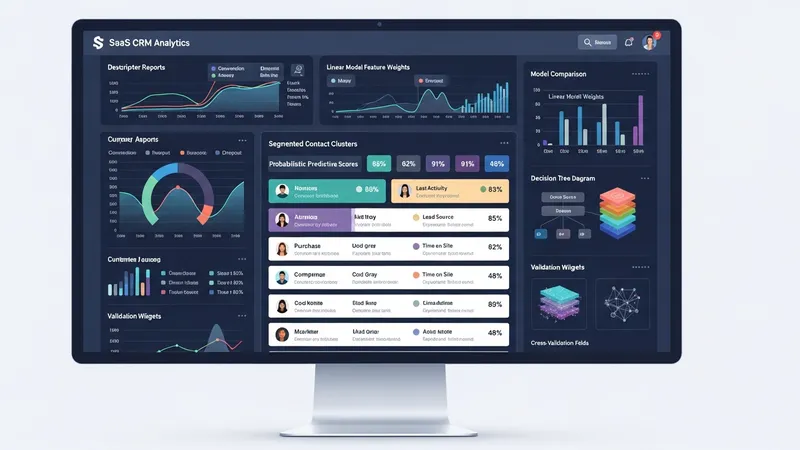
Modeling approaches for predictive scores vary by data richness and desired transparency. Linear and tree-based models often provide interpretable feature importances, while more complex neural architectures can capture nonlinear patterns when large datasets are available. Model validation commonly employs cross-validation and holdout sets, and monitoring for concept drift is used to detect performance decay as customer behavior changes. Teams may also implement mechanisms to surface the most influential features for each prediction to support interpretability.
Analytics outputs are frequently embedded into user interfaces as visual cues—rankings, confidence bands, or recommended next actions—to aid operational use. Dashboards may present funnel metrics, retention curves, and cohort analyses that allow stakeholders to track trends over time. Analysts often use A/B testing frameworks to evaluate whether model-driven interventions affect target metrics, recognizing that observed changes may be influenced by confounding factors and thus require careful experimental design.
Data inputs for analytics typically include interaction events, transactional histories, and customer profile data. Data preprocessing steps—such as handling missing values, normalizing timestamps, and constructing behavioral aggregates—are necessary prior to modeling. Data governance around permissible attributes and consent is commonly enforced to ensure analytics respect privacy constraints. These practices support more robust, defensible analytical outputs while acknowledging that predictive scores remain estimates subject to uncertainty.