
AI CRM Software: Understanding Automation, Analytics, And Personalization

AI-enabled customer relationship management software refers to systems that use machine learning, natural language processing, and automated rules to assist in managing customer data, interactions, and lifecycle processes. These platforms typically ingest contact records, interaction histories, and engagement signals to produce actionable outputs such as suggested next steps, prioritized leads, or segmented audiences. The core aim is to convert raw customer data into operational guidance for sales, service, and marketing teams, while preserving auditability and traceability of automated actions.
Such systems combine several functional layers: data ingestion and unification, analytics and model inference, workflow automation, and personalized communication outputs. Automation can include routine task routing and multi-step sequences; analytics often provide descriptive and predictive metrics; personalization engines tailor messages or recommended offers. Each layer may operate with varying degrees of automation and human oversight, and implementations commonly balance model-driven suggestions with configurable business rules to align with organizational processes.
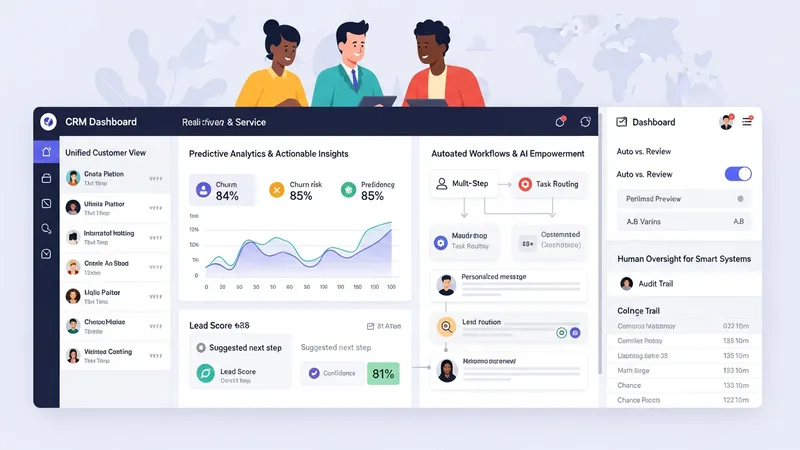
- Predictive lead scoring models — statistical or machine-learning approaches that estimate a prospect’s likelihood of conversion based on historical patterns and current signals.
- Automated workflow orchestration — rule-driven sequences that can route tasks, update records, and trigger emails or notifications when predefined conditions occur.
- Personalization engines for messaging and content — systems that select message variants, timing, or channels for individual contacts using behavioral and profile data.
Predictive lead scoring models often combine demographic, firmographic, and behavioral features to produce a relative score that may help prioritize outreach. Scores typically reflect probabilistic estimates rather than certainties and can be recalibrated as new data arrive. Common modelling approaches include logistic regression, gradient-boosted trees, and simpler heuristic models; choice of approach often depends on data volume, required interpretability, and integration needs. Scores may be accompanied by feature explanations to support human review and to reduce reliance on opaque outputs.
Automated workflow orchestration in AI CRM software can reduce manual repetition by sequencing tasks and integrating cross-system events. Workflows may encompass lead assignment, follow-up reminders, or escalation steps for service cases. These sequences frequently mix deterministic rules (if-then logic) with AI-driven triggers (e.g., a sudden drop in engagement). Organizations typically maintain override controls and logging to enable staff to review automated steps, and testing environments are often used to validate workflows before broad deployment.
Personalization engines in CRM contexts typically use segmentation, propensity scores, and content selection rules to determine which message variant or channel to use for a given contact. Personalization can be as simple as inserting a name and preferred language or as complex as selecting dynamic content blocks based on inferred interests. Privacy constraints and consent settings commonly shape which attributes are usable for personalization, and marketers often monitor engagement metrics to iteratively refine personalization strategies without assuming uniform effects across all audiences.
Integrating these components requires attention to data quality, schema alignment, and operational governance. Data unification commonly involves deduplication, canonicalization of fields, and consistent event schemas so that predictive models and workflows operate on a single source of truth. Model lifecycle management — training, validation, and drift monitoring — often sits alongside change control for workflow rules. Teams typically establish roles for data stewards and process owners to maintain alignment between automated behaviors and business objectives while retaining visibility into automated decisions.
In summary, AI-enabled CRM systems assemble data ingestion, predictive analytics, workflow automation, and personalization to support customer-facing activities without removing human oversight. Implementations may vary in complexity and often emphasize explainability, governance, and iterative tuning. The next sections examine practical components and considerations in more detail.