
Healthcare Revenue Cycle Management: Key Stages From Patient Intake To Payment Posting

The revenue cycle in healthcare refers to the sequence of administrative and clinical tasks that begin when a person first requests services and end when payment for those services is recorded. This sequence typically covers collecting demographic and insurance data, confirming coverage and eligibility, translating clinical encounters into billable codes, sending claims to payers, receiving payments, and reconciling accounts. The process combines front-office interactions, back-office billing activities, and technical interfaces that move information between providers, payers, and patients.
Within this sequence, accuracy and timeliness are central concerns because errors at early stages can propagate and affect claim adjudication and cash flow. Different functions may be supported by specialized tools or workflows: electronic intake platforms to capture patient data, automated verification services to check benefits, coding tools to assign procedure and diagnosis codes, claim scrubbing to reduce errors before submission, and posting systems to record payments and adjustments. Each stage may involve documentation, quality checks, and compliance with privacy and billing rules.
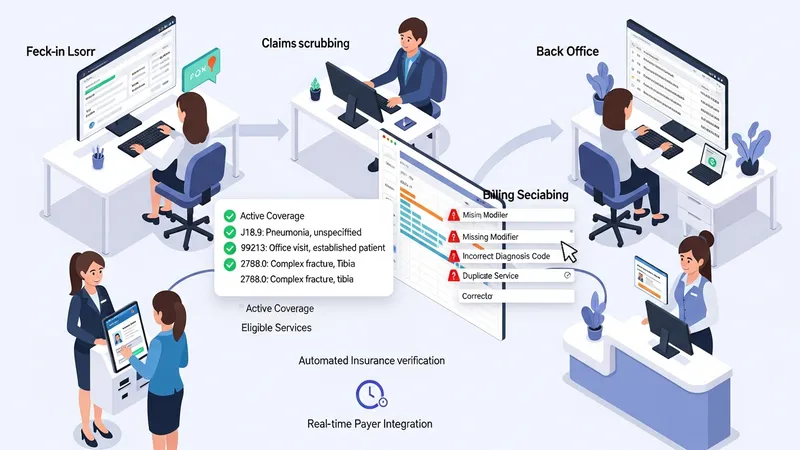
- Electronic patient registration platforms — software that captures demographic and consent information, can interface with scheduling systems, and may include identity verification and patient responsibility estimation.
- Automated insurance eligibility and benefits verification services — systems or APIs that check payer enrollment, plan details, and prior authorization requirements in near real time.
- Coding and billing software with claim-scrubbing features — tools that assist with assigning standardized codes (e.g., diagnosis and procedure codes), apply edits, and prepare claims for submission to clearinghouses or payers.
Front-end intake systems often aim to reduce manual entry and improve data quality by using structured fields and validation rules. Electronic registrations can typically integrate with scheduling and electronic health record (EHR) systems so that demographic and insurance data flow forward without rekeying. Accurate collection of primary and secondary payer details, address verification, and consent documentation may reduce downstream denials. Some platforms also include patient-facing portals to capture pre-visit forms which can shorten in-clinic processing times and help staff focus on verification tasks.
Insurance eligibility and benefits checks may occur at multiple points: at scheduling, at check-in, and prior to certain services where prior authorization is commonly required. Automated verification services can often query payer systems or use data aggregators to return coverage status and cost-share estimates; however, returned results may vary by payer and plan and typically require staff review for complex cases. Early verification may help set appropriate expectations for financial responsibility and identify coverage limitations that could affect coding or authorization requirements.
Coding and claims preparation rely on accurate clinical documentation and standardized code sets. Coders and coding software often translate documented diagnoses and procedures into codes such as ICD and CPT (or other regional equivalents). Claim-scrubbing tools apply edits to detect missing or inconsistent elements, which may reduce rejections at the payer gateway. Nevertheless, ambiguous documentation or clinical detail gaps can lead to coder queries or claims adjustments; maintaining clinical documentation integrity processes can help align clinical notes with billing requirements.
Payment posting and reconciliation close the administrative loop by matching remittance advice to posted payments and adjustments. Electronic remittance advice (ERA) and electronic funds transfer (EFT) formats may automate parts of posting, but exceptions and partial payments often require manual review. Accurate posting supports aging reports and revenue analytics and may affect patient billing statements. Reconciliation processes typically identify differences between expected and received amounts, categorizing them for follow-up such as appeals, refunds, or contractual adjustments.
In summary, the series of steps from initial contact through final posting describes a coordinated set of administrative and clinical activities that together influence cash flow, compliance, and patient experience. The examples listed — registration platforms, eligibility services, and coding/billing software — illustrate common tool types used across these stages and may integrate to varying degrees. The next sections examine practical components and considerations in more detail.