
Exploring Oncology Advancements: From Biomarkers To Personalized Treatment Pathways

Clinical Research, Regulatory Considerations, and Future Directions in Personalized Oncology Pathways
Clinical research designs continue to inform how biomarkers are incorporated into treatment pathways. Master protocols such as umbrella and basket trials enable study of targeted agents across molecular subgroups or tumor types, producing evidence that pathway designers may reference. Adaptive trial features can refine inclusion criteria as signals emerge. When integrating trial-derived evidence into pathways, teams often note the context and applicability of findings to routine care and whether additional confirmatory data are needed before altering standard management.
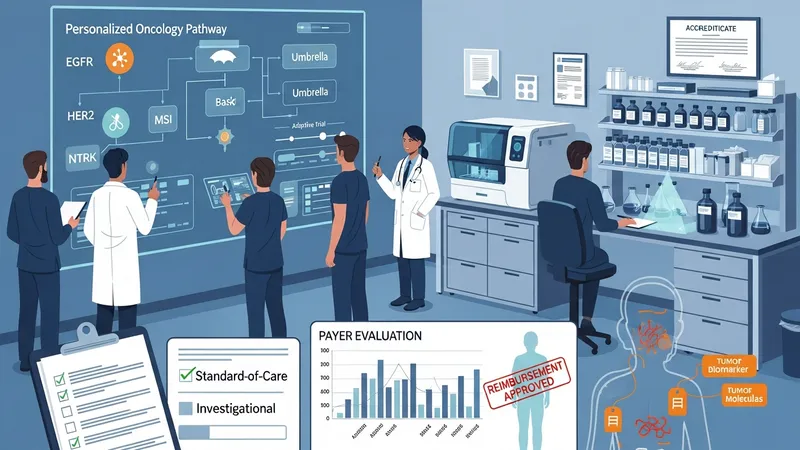
Regulatory and reimbursement landscapes influence pathway adoption and accessibility. Diagnostic tests may be offered through clinical laboratories under accreditation standards, and some assays pursue regulatory clearance where required. Coverage policies and payer evaluations often assess clinical utility and cost-effectiveness, which can affect which tests are routinely available. Pathways typically account for these practical constraints by delineating which tests are standard-of-care, which are investigational, and by documenting alternative steps when certain assays are not accessible.
Emerging innovations that may shape future pathways include multi-omics integration, single-cell analyses, spatial transcriptomics, and algorithmic models that predict response by synthesizing diverse data streams. These approaches may increase resolution of tumor biology and inform more granular pathway steps, but they also introduce complexity in data interpretation, infrastructure needs, and validation requirements. Pathway developers generally adopt a staged approach to incorporating such innovations, balancing potential informational gain against current evidence and operational feasibility.
Ethical and equity considerations are integral to pathway design. Ensuring equitable access to molecular testing, avoiding bias in algorithmic tools, and transparently communicating the limits of evidence are commonly cited considerations. Pathways may include mechanisms for informed consent, clear documentation of uncertainty, and processes to revisit decisions as new data emerge. These design elements help align personalized treatment pathways with broader goals of responsible, patient-centered care as the field continues to evolve.